
Introduction
When a family starts looking for a nursing home, the first questions are usually about location, cost, and whether the place looks clean. Those things matter. But after years of working in senior care, I can tell you the single factor that determines whether your loved one thrives or simply gets by is the people taking care of them every single day.
Not the building. Not the activity calendar posted on the wall. The caregivers.
A facility can have brand new furniture and a beautifully landscaped garden, but if the staff is undertrained, overworked, or indifferent, your family member will feel it. They will feel it in how long they wait for help after pressing a call button. They will feel it in whether someone remembers how they like their eggs in the morning, or stops to talk with them when they seem lonely.
This guide is for families in Auburn, Washington who are navigating one of the hardest decisions they will ever make. We want to help you look past the brochure photos and understand what actually separates a good care environment from one that falls short.
The answer, almost every time, starts with the caregivers.
What Actually Makes a Nursing Home Good for Seniors
Families touring facilities tend to notice the surfaces: the common room, the dining area, how the halls smell. These are reasonable things to notice. But they tell you very little about the quality of day to day care.
A truly good care environment has a few things in common. There is enough staff on every shift so no one is rushing through care. Caregivers know the residents by name and by history. Families feel welcome to visit at any hour. Concerns get addressed quickly and honestly.
The physical environment matters too, of course. Safety features, private or semi private rooms, clean common spaces, accessible bathrooms, and outdoor areas all contribute to quality of life. But these are the floor, not the ceiling.
The ceiling is determined by the people. How a caregiver responds when a resident wakes up frightened at 2 a.m. How they handle a difficult personal care moment with dignity. Whether they notice when someone who normally talks a lot goes quiet for a few days.
That kind of attentiveness cannot be painted on or staged for a tour. You either have a staff that cares, or you do not.
Who Are Certified Caregivers for Seniors?
The term caregiver gets used loosely, so it helps to understand what it actually means in a licensed care setting.
Certified caregivers for seniors have completed state approved training programs that cover personal care, safety protocols, infection control, emergency response, and often dementia or memory care. In Washington State, caregivers working in adult family homes and assisted living facilities are required to meet specific certification standards set by the Department of Social and Health Services.
That baseline certification matters. But it is just the starting point.
The best caregivers bring something beyond their certification: genuine interest in older adults as people. They understand that a senior who needs help bathing is not defined by that need. They approach personal care with patience, conversation, and respect. They understand that humor, familiarity, and small kindnesses are not extras. They are part of the care.
When families search for professional caregivers Auburn WA or look up senior caregiver services, they should be thinking about this whole picture: someone who is trained, yes, but also someone who is genuinely suited for this kind of work.
Not everyone is. And that is not a criticism. It simply means families should pay attention to how staff members interact with residents during any facility visit, not just what they say to you at the front desk.
Why Training and Experience Both Matter
There is sometimes a tension between formal training and practical experience, but the best caregivers have both.
Training gives caregivers a framework. They learn how to safely transfer a resident from bed to wheelchair. They learn the warning signs of a urinary tract infection, which in older adults can present as sudden confusion rather than obvious physical symptoms. They learn how to respond if a resident with dementia becomes agitated, and they learn which approaches can make things worse.
Experience teaches caregivers how to apply all of that in the messy, unpredictable reality of daily care. It teaches them to read between the lines when a resident says I’m fine but their eyes say something different. It teaches them which family members want detailed updates and which prefer a simple reassurance call.
Trained caregivers for elderly residents who also bring years of real world experience are genuinely rare. When a facility has staff like this, it shows immediately. The environment feels calmer. Residents seem more at ease. Families stop worrying as much because they trust the people on the floor.
When you visit a facility, ask how long the caregivers have been there. High turnover is one of the biggest red flags in senior care. If staff are constantly coming and going, residents never get to build the kind of trust and familiarity that makes them feel secure.
What Caregivers Actually Do Each Day
People sometimes picture caregiving as mainly physical tasks, like helping with bathing and dressing. That is part of it. But the daily role of a caregiver in a senior care setting is much broader than that.
A typical day for a senior care staff member might include:
- Helping residents wake up, get dressed, and prepare for the day
- Assisting with meals and making sure residents are eating and drinking enough
- Supporting mobility and helping with exercises or physical therapy routines
- Administering medications or ensuring they are taken correctly and on schedule
- Monitoring for changes in health, mood, or behavior and documenting observations
- Engaging residents in activities, conversation, and social time
- Communicating updates to nurses, family members, and other care team members
That last point is often underestimated. Caregivers are the eyes and ears of the care team. Because they spend the most time with residents, they are often the first to notice that something has changed. Maybe a resident who normally enjoys breakfast is picking at their food. Maybe they are moving more slowly than usual, or they seem more confused at night.
A good caregiver catches these things early and brings them to the attention of the medical team. That kind of watchfulness can prevent a minor issue from becoming a serious one.
Emotional Support and the Power of Human Connection
One of the hardest parts of moving into a care facility is loneliness. Even in a house full of people, a senior can feel profoundly alone if no one takes the time to actually connect with them.
Research on aging consistently shows that social connection is tied to physical health outcomes. Loneliness is not just an emotional problem. It affects sleep, immune function, cognitive sharpness, and even how quickly wounds heal. The emotional dimension of caregiving is not a soft extra. It is a core part of the health picture.
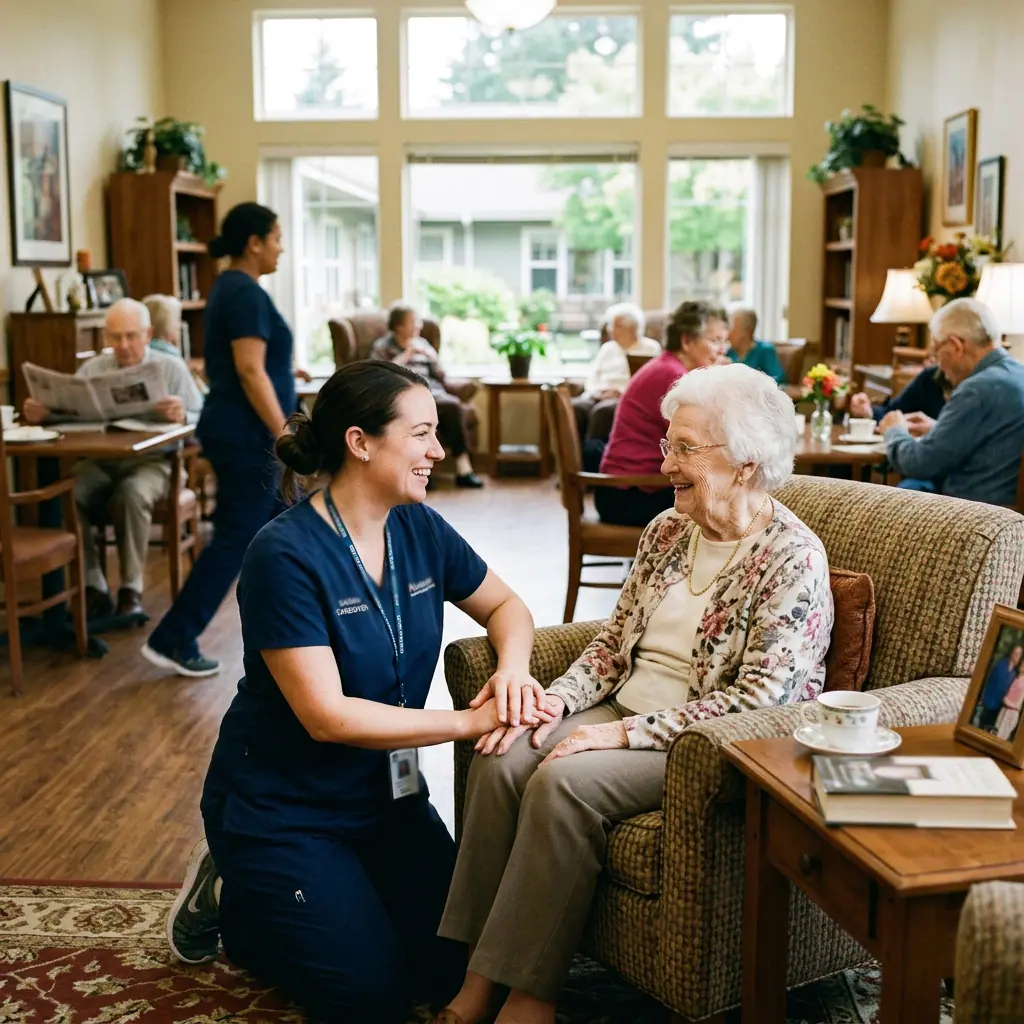
Good caregivers understand this. They sit down with a resident during a slow moment to hear about their grandchildren. They remember that someone used to love a certain kind of music and put it on during personal care. They notice when someone is having a hard day and they adjust their approach, maybe slowing down, speaking more softly, or simply staying a little longer in the room.
These moments do not appear on any billing report. They do not show up in a facility’s star rating. But they are what make the difference between a resident who feels cared for and one who is just being managed.
When you are evaluating in home caregivers for seniors or visiting a residential facility, watch how staff members interact with the people already in their care. Are they warm and unhurried? Do they make eye contact? Do residents seem comfortable around them? These observations will tell you more than any brochure.
Medical Awareness and Keeping Seniors Safe
Caregivers are not nurses or doctors. But they work closely alongside medical professionals, and their day to day awareness is a critical layer of safety for the people in their care.
Understanding medication basics is one example. Many older adults take multiple medications, and interactions or incorrect dosing can cause serious harm. A careful caregiver ensures the right medications are taken at the right times and flags anything that seems unusual, like a sudden increase in drowsiness after a new prescription starts.
Fall prevention is another area where attentive caregivers make an enormous difference. Falls are the leading cause of injury for adults over 65, and many of them are preventable. Caregivers who know a resident well understand their particular risks: maybe they tend to get up quickly without waiting for assistance, or they become unsteady in the late afternoon, or they are reluctant to use their walker. A caregiver who knows this can take steps to reduce that risk.
Skin integrity is another concern, particularly for residents with limited mobility. Pressure injuries can develop quickly and become serious if not caught early. Caregivers who are thorough and observant during personal care routines will notice the early signs and ensure proper repositioning and skin care happens consistently.
Families looking for senior care centers with immediate access to medical staff are right to prioritize this. But that access is only as useful as the frontline caregivers who recognize when to use it. The caregiver who notices a change and escalates it appropriately is often the reason a health crisis gets caught before it becomes a hospital visit.
Nursing Homes, Assisted Living, and Adult Family Homes: What Is the Difference?
Many families use these terms interchangeably, but they describe different types of care environments. Understanding the differences helps families make a more informed choice.
Nursing Homes
Traditional nursing homes in Auburn are larger facilities offering skilled nursing care around the clock. They are appropriate for residents who have complex medical needs requiring regular nursing oversight, like wound care, IV medications, or intensive rehabilitation. The trade off is often a more clinical environment and less individual attention due to the higher resident to staff ratio.
Assisted Living
Assisted living communities offer more independence for seniors who do not need full nursing care but need help with some daily activities. They typically provide meals, housekeeping, personal care, and medication management, with activities and social programming as well. These communities vary widely in size, cost, and quality.
Adult Family Homes
Adult family homes Auburn WA are a model of care that many families find when they look beyond the obvious options, and often they are surprised by what they find. These are smaller, licensed residential settings, typically housing six or fewer residents, where care is provided in a genuine home environment.
The smaller scale changes everything. Caregivers know each resident well. Routines are built around the individual, not the schedule of a large institution. Meals can be made with specific preferences in mind. Families often describe the atmosphere as more like a family than a facility.
For many seniors, particularly those who value personal attention and do not thrive in larger institutional settings, an adult family home can offer a level of care quality that a larger facility simply cannot match. This is especially true when it comes to the caregiver relationship.
What Families Should Look for in Caregivers
When you visit any senior care facility, whether you are looking at nursing homes in Auburn or a smaller residential setting, you are essentially interviewing the people who will be responsible for someone you love. Here is what to pay attention to.
How they interact with current residents
This is your best real world preview. Watch whether caregivers acknowledge residents when they pass them in the hall. Do they knock before entering a room? Do they speak to residents as adults, not as children? Do they seem genuinely engaged or just going through the motions?
Staff stability
Ask how long the caregivers on staff have been there. Ask about turnover. A stable care team is a sign of good management and a workplace culture where people want to stay. Residents in these settings tend to be calmer and more trusting.
Training and ongoing education
Ask what certifications caregivers hold and whether the facility invests in ongoing training. Senior care best practices evolve, particularly around dementia, fall prevention, and mental health. A facility that prioritizes continuing education is one that takes quality seriously.
Staffing ratios
Ask how many residents each caregiver is responsible for, especially during overnight shifts. Even well trained and compassionate caregivers cannot provide good care if they are stretched too thin. This is one of the most important practical questions a family can ask.
Questions to Ask Before Choosing a Facility
Touring a facility is much more productive when you go in with specific questions. Here are some of the most useful ones.
- What is the caregiver to resident ratio on day shifts? On overnight shifts?
- What certifications do your caregivers hold, and what ongoing training do you provide?
- How long have most of your current caregivers been with the facility?
- How do you handle it when a resident’s care needs change or increase?
- What does a typical day look like for a resident here?
- How are families kept informed about their loved one’s health and wellbeing?
- Can I speak with a current family member or resident about their experience?
- What is your process when there is a medical concern or emergency?
- How are caregivers supervised and evaluated?
Pay attention not just to the answers but to how they are given. Defensive or vague responses to straightforward questions are a red flag. Good facilities are proud of their care and happy to be transparent.
Understanding Senior Care Options in Auburn, Washington
Auburn is a growing city in the South King County area with a range of senior care options. Families here have access to large nursing facilities, assisted living communities, memory care units, and smaller residential options including adult family homes.
Senior care in Auburn has expanded in recent years as the local population ages. That is broadly good news for families, because more options mean more ability to find a care environment that fits a particular person’s needs and preferences.
When families search for senior caregiving services near me or look into the best nursing homes with highly trained elderly caregivers near me, they are starting a process that takes time and personal judgment. No online search can fully substitute for visiting a facility, speaking with staff, and spending time with the people who are already residents there.
One option in Auburn worth knowing about is Cherished Acres Adult Family Home. It is a smaller, licensed residential care setting focused on individualized attention and consistent, relationship based care. Families who have found that their loved one struggles in larger institutional environments often find the adult family home model a much better fit. The smaller size makes it possible for caregivers to genuinely know each resident and provide care that feels personal rather than procedural.
Whatever option a family ultimately chooses, the core question should always be the same: who will be with my loved one every day, and can I trust them to provide care with skill and with heart?
Common Mistakes Families Make When Choosing Senior Care
Looking only at ratings and star systems. These can be useful as a starting point, but they do not capture the texture of daily care. A facility with four stars might have high staff turnover or a recent change in ownership that has disrupted care quality. Always visit in person.
Choosing based on location alone. Proximity to family is a real consideration, but it should not override the quality of care. A slightly farther facility with excellent caregivers will serve your loved one better than a closer one where staff is stretched thin or poorly supervised.
Touring only once, and only during business hours. Consider visiting on a weekday evening or a weekend morning. How a facility operates when the director is not present tells you a great deal about its real culture.
Not asking about what happens when needs increase. Many families choose a facility based on current needs without thinking ahead. A good facility will have a plan and honest communication about what is possible as a resident’s condition changes over time.
Rushing the decision because of a hospital discharge deadline. This is one of the most common situations families find themselves in, and it leads to some of the worst decisions. Whenever possible, start researching care options before a crisis, so you have time to visit, ask questions, and make a thoughtful choice.
Ignoring gut feelings during tours. If something feels off during a visit but you cannot put your finger on it, take that seriously. Your instincts are picking up on something real.
Frequently Asked Questions
What qualifications should certified caregivers for seniors have?
In Washington State, caregivers in licensed care settings must complete state approved basic training and ongoing continuing education. Many caregivers also hold certifications as nursing assistants or have additional specialized training in dementia care, fall prevention, or palliative care. Beyond formal credentials, look for caregivers who have meaningful experience working with older adults and a demonstrated track record in the role.
How is an adult family home different from a nursing home?
Nursing homes are larger licensed facilities designed for residents with significant medical needs, with nursing staff available around the clock. Adult family homes are smaller residential settings, usually licensed for six or fewer residents, offering a home like environment with personalized care. Many families find the smaller setting better suited to seniors who value familiarity, routine, and individual attention.
What is a reasonable caregiver to resident ratio?
This varies by setting and level of care needs. In larger nursing facilities, ratios during day shifts might be one caregiver to six or eight residents. In adult family homes, the much smaller resident count allows for significantly more individual attention. Ask specifically about overnight ratios, which is when many facilities reduce staffing and risks increase.
How can I tell if a caregiver is well trained during a facility visit?
Watch how caregivers interact with residents who are currently in the facility. Trained caregivers speak respectfully, use proper body mechanics when assisting with movement, knock before entering rooms, and respond to residents calmly even in challenging moments. You can also ask directly about their training background and how long they have been in senior care.
What should I do if I am unhappy with the care my family member is receiving?
Start by speaking directly with the facility administrator or director of care. Document your concerns and keep records of any conversations. If the issue is not resolved, Washington State’s Long Term Care Ombudsman program provides free advocacy services for residents of nursing homes, assisted living, and adult family homes. You can also contact the Washington State DSHS Aging and Long Term Support Administration to file a formal complaint.
Is in-home care an option instead of a residential facility?
For many seniors, in-home care is a good option, particularly in the earlier stages when the level of need is moderate. In-home caregivers for seniors can provide personal care, companionship, medication reminders, and light household help in a person’s own home. However, as needs increase, especially if someone requires 24 hour supervision or complex medical support, a residential care setting often provides better safety and more consistent care.
Choosing Care Is Choosing People
If you take one thing away from this guide, let it be this: when you are choosing a care setting for someone you love, you are really choosing the people who will be with them every day.
The building does not hold their hand when they are scared. The activity calendar does not notice when their appetite has dropped. The website photo of the cheerful common room does not help them through a painful morning or comfort them when they miss home.
The caregivers do all of that.
Families who take time to really evaluate the care team, not just the facility, consistently make better decisions. They ask harder questions. They visit more than once. They watch how the current residents are treated. And they trust the caregivers they meet or they walk away and keep looking.
That kind of careful approach is not demanding. It is being a good advocate for someone who needs you to be one.
Senior care in Auburn offers real options for families willing to look carefully. Whether you are considering a large nursing facility, a mid sized assisted living community, or a smaller adult family home, the standard is the same: your loved one deserves certified caregivers for seniors who are trained, experienced, compassionate, and present.
If you have questions about what that looks like in practice, or you want to understand what a smaller home style care environment can offer, we welcome families to come and see for themselves. At Cherished Acres Adult Family Home in Auburn, WA, the door is open. We would rather you ask every hard question than settle for anything less than the care your family member deserves. Read more