
When the Bills Are More Than You Can Handle
The call nobody wants to make is the one where you have to ask, How are we going to pay for this?
Maybe your mom had a stroke last month and the hospital is already talking about discharge. Or your dad has been falling at home, and the doctor is gently but firmly saying he needs more care than the family can safely provide. You look into nursing homes, you see the price tags, and your stomach drops.
Thousands of dollars a month. Sometimes more. And you have no idea where that money is going to come from.
You are not alone in this. Most families are not prepared for the cost of long term senior care. It is one of those things nobody really talks about until it is suddenly urgent. And when you are already stressed and exhausted and scared, trying to figure out the financial side feels impossible.
This guide is for you. It is written to help you understand your real options when money is tight, and to show you that there are genuine pathways to get your loved one the care they need, even without private funds.
We will walk through government programs, local resources, and alternative care settings. We will also touch on what families in places like Auburn, Washington are doing to find quality, affordable care close to home.
What Happens If You Simply Cannot Afford a Nursing Home?
A lot of families ask this question in a panic. The short answer is that no one in the United States is supposed to be left without care simply because they have no money.
The longer answer is that it takes some navigation. The system is not always easy to move through. But resources exist.
The most important thing to understand is this: Medicaid, the joint federal and state health insurance program for people with limited income and assets, is designed specifically to cover long term care costs for those who qualify. It is the single biggest payer of nursing home care in the country.
But Medicaid is not the only option. There are also Veterans benefits, state assistance programs, nonprofit care organizations, and alternative care settings that cost far less than traditional nursing homes.
If your family is facing this situation right now, take a breath. There is a path forward. It may require paperwork, patience, and possibly some professional help, but people navigate this every single day.
Does Medicare Pay for Nursing Homes?
This is one of the most common misunderstandings families have. And it causes real problems when people count on Medicare and then find out, too late, what it actually covers.
Medicare does cover short term skilled nursing care under specific conditions. If a person is hospitalized for at least three days and then requires skilled nursing care or rehabilitation, Medicare will pay for up to 100 days in a Medicare certified facility. The first 20 days are covered in full. After that, there is a significant daily co-pay that can run over $200 per day. After day 100, Medicare coverage stops entirely.
What Medicare does not cover is custodial care. That is the kind of care most people need in a nursing home, things like help with bathing, dressing, eating, or just being safe and supervised throughout the day. If a person does not need skilled medical intervention every day, Medicare is not going to keep paying.
This is where families get blindsided. Someone’s parent is doing fine medically, just frail and no longer safe alone, and the Medicare bill suddenly stops. That is the moment the hard conversation about long term funding has to happen.
So yes, Medicare is helpful in the short term after a hospitalization. But for true long term nursing home care, it is not a sustainable funding source. That is where Medicaid comes in.
How Medicaid Helps Cover Nursing Home Costs
Medicaid is the program most families ultimately rely on when private funds run out. In Washington State, Medicaid is administered through the Washington Apple Health program, and it covers a broad range of long term care services, including nursing home stays.
Here is what most people do not realize: Medicaid does not require you to be completely destitute from the very start. Many people with modest savings or assets eventually qualify after they have spent down their resources on care. This is called the Medicaid spend down process.
It works like this. A person pays for their own care out of pocket until their assets drop to the Medicaid eligibility threshold, which in Washington State is generally around $2,000 in countable assets for a single person. Once they hit that threshold, they can apply for Medicaid, and coverage can begin going forward.
There are also rules around the spouse of a nursing home resident. A healthy spouse living at home, sometimes called the community spouse, is allowed to keep more assets and a portion of the household income. These protections exist so that one spouse does not become impoverished because the other needs nursing home care.
Who Qualifies for Medicaid in Washington State?
Eligibility depends on several factors. Income, asset levels, age or disability status, and level of care all play a role.
Generally speaking, to qualify for Medicaid long term care in Washington:
- You must be 65 or older, or have a qualifying disability
- Your income must fall below a certain threshold, though rules vary by program
- Your countable assets must be below approximately $2,000 for an individual
- A physician must certify that you need a nursing level or assisted living level of care
Some assets are not counted. Your primary home, one vehicle, personal belongings, prepaid burial arrangements, and certain other items are typically excluded. This is why it is worth speaking with a Medicaid planner or elder law attorney before assuming you will not qualify.
The application process can take weeks or sometimes longer. Starting early is critical.
What Services Does Medicaid Cover?
In Washington, Medicaid funded long term care can cover a wide range of settings and services:
- Skilled nursing facility care (traditional nursing homes)
- Assisted living facilities that are Medicaid certified
- Adult family homes, which are small residential care homes for seniors
- In-home personal care services
- Adult day health programs
- Memory care in certified facilities
The goal of Washington’s Medicaid program is to allow people to receive care in the least restrictive setting that meets their needs. This means that if someone can be safely cared for in an adult family home or through in-home services, Medicaid will often fund that before placing them in a larger nursing facility.
Other Ways to Pay for Senior Care When Money Is Short
Medicaid is the main resource, but it is not the only one. Depending on your family’s situation, one or more of these options might also be helpful.
Veterans Bene
fitsIf your loved one served in the United States military, the VA offers several programs that can help cover care costs. The Aid and Attendance benefit, in particular, can provide meaningful monthly payments to help offset the cost of assisted living, nursing home care, or in-home care.
VA benefits can sometimes be combined with Medicaid, and there are specific facilities that are VA certified. If your family member is a veteran, this is worth exploring as soon as possible. The application process takes time.
Long Term Care Insurance
Some seniors planned ahead and purchased long term care insurance. If your loved one has a policy, check the terms carefully. Coverage varies widely, but good policies can pay for months or even years of nursing home or assisted living care.
Look through any insurance documents carefully. Some people forget they even have a policy, or family members are unaware it exists.
Life Insurance Policy Conversions
Certain life insurance policies can be converted into long term care benefits through a life settlement or a policy conversion program. This is something a financial advisor or elder care attorney can help you explore.
Annuities and Reverse Mortgages
If a senior owns a home, a reverse mortgage can unlock equity to help fund care. These products are complex and come with real risks and costs, so they should never be entered into without careful advice. But in some situations, they provide meaningful funding for care.
Nonprofit and Community Programs
Some counties and community organizations offer assistance programs for low income seniors. Area Agencies on Aging are a good starting point. In Washington, the Aging and Long Term Support Administration, known as ALTSA, connects families to local resources and can help with care coordination and funding navigation.
Alternative Care Options That Cost Less
One of the things families do not always know is that a traditional nursing home is not the only option for high level care, and it is often the most expensive.
Washington State has a well developed network of smaller, community based care settings that can be significantly more affordable, especially for Medicaid funded residents.
Adult Family Homes
Adult family homes are licensed residential homes where a small number of seniors, typically six or fewer, receive 24 hour personal care. They operate in regular residential neighborhoods and provide meals, medication management, personal hygiene assistance, and supervision.
Because they are smaller, the cost structure is different from large nursing facilities. Many adult family homes in Auburn WA and across the state accept Medicaid. The ratio of staff to residents is often better than in larger institutional settings, and residents frequently benefit from a more homelike environment.
For families with loved ones who need memory care, adult family homes can be especially good options. Small settings tend to be less overwhelming for people with dementia, and consistent caregivers help build trust and routine.
Assisted Living Facilities
Assisted living facilities in Auburn WA and elsewhere offer a middle ground between independent living and skilled nursing. Residents live in private or semi private apartments and receive help with daily activities. Some Medicaid certified assisted living facilities in Auburn accept Medicaid funding, though availability can be limited and waitlists are common.
For seniors who do not yet need the level of care provided in a nursing home, assisted living can be a cost effective choice that still provides safety and support.
In-Home Care
Sometimes the best option, financially and personally, is to keep a senior at home with professional caregiving support. Medicaid Home and Community Based Services can fund in-home personal care for eligible seniors in Washington.
In-home care is not always feasible if care needs are very high, but for seniors who are mobile and cognitively intact, it can work well and allow them to stay in familiar surroundings.
Understanding Local Options in Auburn, Washington
If you are looking at nursing homes in Auburn or exploring senior care options in this area, you are in a community with a real range of resources available.
Auburn is part of King County, which has solid infrastructure for senior care navigation. Through King County’s Aging and Disability Services, families can access care coordinators, benefit counselors, and assistance with Medicaid applications.
Local assisted living facilities Auburn WA include both large facilities and smaller, more intimate settings. For seniors who need memory care or close personal attention, smaller residential care homes for seniors, including adult family homes, are often available in and around the Auburn area.
Senior care in Auburn spans a range of settings. When comparing options, it is important to ask each facility directly about Medicaid acceptance, current availability, and what the transition process looks like if a resident runs out of private funds mid stay.
Cherished Acres Adult Family Home
One example of a small residential care option in the Auburn area is Cherished Acres Adult Family Home. Like other licensed adult family homes in Washington, it provides personalized care in a home based setting for a small number of residents. Families looking into care homes for seniors in the Auburn area may want to include smaller settings like this in their search, particularly when evaluating the balance between cost, quality, and personal attention.
Steps Families Should Take If They Have No Money
If you are facing this situation right now, here is a practical sequence to follow. Every family’s situation is different, but this is a solid starting point.
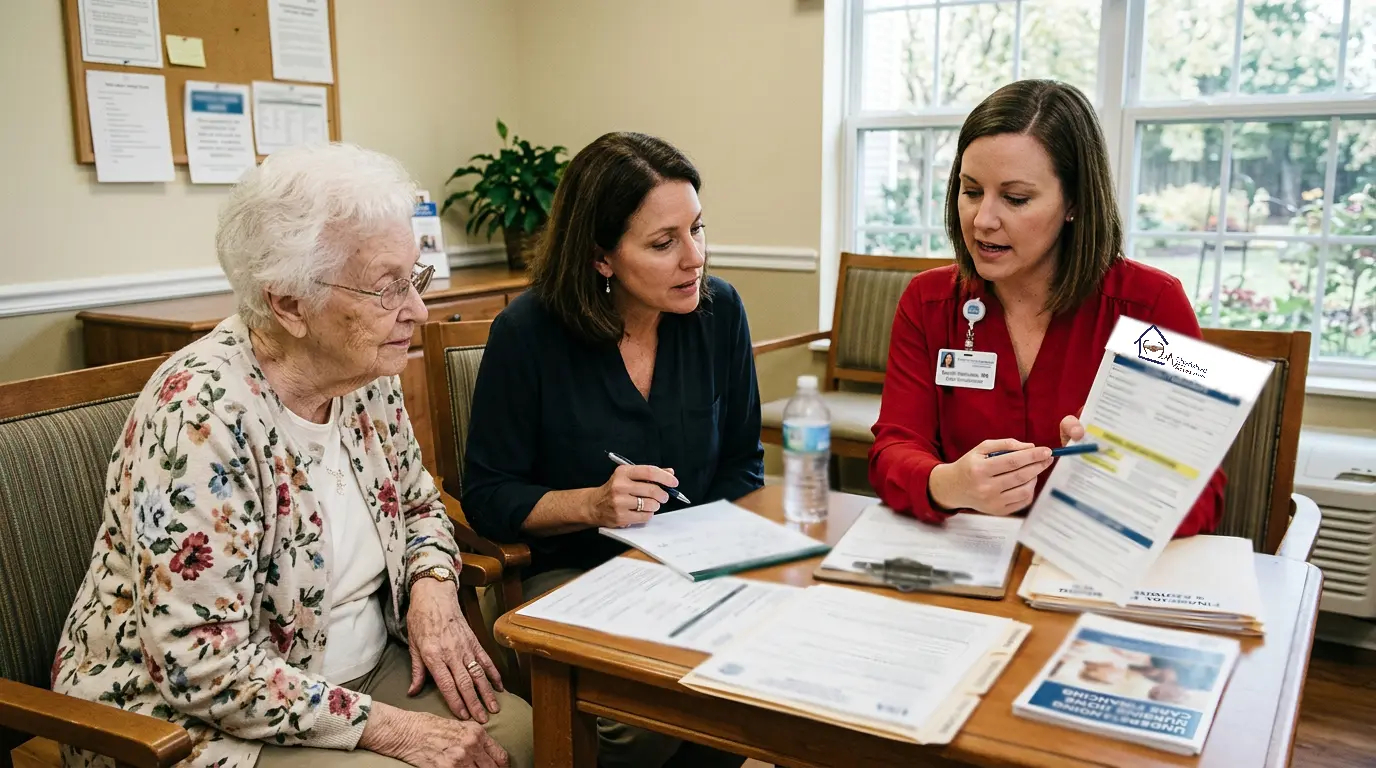
Contact the local Area Agency on Aging. In King County, this is Aging and Disability Services. They offer free counseling and can help you understand what programs your loved one might qualify for.
Gather financial documents. Before you can apply for Medicaid, you will need to document income, assets, and expenses. Having these ready will speed up the process.
Consult an elder law attorney or Medicaid planner. This is especially important if there are assets, property, or family transfers involved. A professional can help you plan legally and avoid costly mistakes.
Apply for Medicaid as early as possible. The application process takes time, and coverage does not start until the application is approved. Do not wait until funds are completely gone.
Research nursing homes in Auburn and surrounding areas that accept Medicaid. Not every facility accepts Medicaid, and some have waitlists for Medicaid beds. Start this process early.
Ask about Veterans benefits if applicable. If your loved one served, contact a VA benefits counselor to explore what is available.
Consider all care settings, not just traditional nursing homes. Adult family homes, assisted living, and in-home care may all be options that fit both the care need and the budget.
Common Mistakes Families Make
A few missteps are worth knowing about in advance, because they can seriously complicate the situation.
Transferring Assets to Qualify Faster
Giving away money or property to family members shortly before applying for Medicaid is one of the most serious mistakes families make. Medicaid has a five year look back period. If the agency finds that assets were transferred in the five years before application, it can impose a penalty period during which Medicaid will not pay for care.
This catches families off guard. They think they are helping. In reality, it can leave a loved one without coverage at the worst possible time.
Waiting Too Long to Apply
Because Medicaid applications take time to process, families who wait until a loved one is completely out of money before applying often face a gap in coverage. Start the process early, even if you are not sure you will qualify yet.
Not Asking About Medicaid Acceptance Upfront
Some facilities say they accept Medicaid but have very few Medicaid beds, or they only accept Medicaid for residents who transferred in from private pay. Always ask directly and get the answer in writing if possible.
Assuming Care Quality Reflects Cost
Some families assume that lower cost settings, like adult family homes or Medicaid funded nursing facilities, will provide inferior care. This is not necessarily true. Many smaller care settings provide excellent, attentive care precisely because they are smaller and more focused.
Frequently Asked Questions
Can a nursing home turn you away if you have no money?
If you are applying for Medicaid, nursing homes that participate in Medicaid cannot discriminate against you solely based on payment source. However, facilities can decline admission based on care needs they are not equipped to meet, or because they do not have available Medicaid certified beds. Shopping around and starting early is key.
What happens if I run out of money while already in a nursing home?
This is a common situation. If you are already a resident and your private funds run out, you can apply for Medicaid at that point. If the facility accepts Medicaid and has Medicaid beds available, they are generally required to continue your care. Talk to the social worker at the facility as soon as you anticipate this happening. Do not wait until the last minute.
Can family members be required to pay for a parent’s nursing home care?
In most states, including Washington, adult children are not legally required to pay for a parent’s nursing home care from their own funds. There are some exceptions in states with filial responsibility laws, but Washington does not have strong enforcement of these laws for nursing home situations. You should not feel pressured to drain your own savings to pay for a parent’s care.
What is the difference between a nursing home and an adult family home?
A nursing home, or skilled nursing facility, is a larger institutional setting that provides 24 hour nursing care for people with significant medical needs. An adult family home is a small, licensed residential home for a small group of seniors, typically up to six, who need personal care and supervision but may not need intensive medical intervention daily. Adult family homes often provide a more homelike atmosphere and in many cases are Medicaid funded.
Are there waiting lists for Medicaid nursing home beds?
Yes, in many areas, including Auburn and the surrounding King County region, Medicaid beds in nursing facilities and adult family homes can have waiting lists. This is another reason to start planning early. Getting on multiple waitlists simultaneously is a smart strategy.
Does the home need to be sold to pay for nursing home care?
The primary home is generally considered an exempt asset for Medicaid purposes while the owner is living. However, after the person passes away, the state may seek to recover Medicaid costs paid on their behalf through a process called estate recovery, which can involve the home. A Medicaid planner or elder law attorney can help you understand how this works in your specific situation.
You Do Not Have to Figure This Out Alone
The fear of not being able to afford care for someone you love is real. And the system that is supposed to help can feel confusing and overwhelming when you are already stressed.
But help exists. Medicaid covers long term care for millions of Americans every year. Washington State has programs specifically designed to help seniors in nursing homes near you get quality care regardless of their financial situation. And local resources, from county aging services to adult family homes in Auburn and surrounding communities, are there to support families through exactly this kind of transition.
If you are exploring options for a loved one in the Auburn area, start by calling the local Area Agency on Aging, or reaching out directly to long term care homes for seniors in your area to ask about Medicaid acceptance, availability, and how the admissions process works.
You will find that most people working in this field genuinely want to help. Ask your questions. Be honest about your situation. Take notes and do not be afraid to follow up.
The most important thing you can do right now is take the first step. Make that call. Start the paperwork. Ask one facility one question. Every bit of progress you make brings you and your loved one closer to a safe, supported situation. Read more